
To understand what actually happens when a wholesale order for women’s business suits is placed, it helps to sit down with the people who cut, sew, and ship them. On a production floor in Hubei, China, where LCBZ runs its tailoring lines, the conversation quickly moves past fabric swatches and into the details that never make it into a catalog: how sizing systems are built, what happens when a buyer’s customers fall between two sizes, and why some wholesale programs fail before the first carton ships. The people who make the suits have clear opinions, and they are worth listening to.
We started by asking Ms. Li, the production director, about the question she hears most often from new wholesale clients. “They ask for ‘standard European sizing’ and expect that to mean one thing,” she says. “It does not. A size 38 in one market is not a size 38 in another, and the same letter size fits differently depending on the pattern block behind it.” That is why her team insists on agreeing measurement tables before production. When a buyer orders in bulk, the measurement chart, not the size label, becomes the contract. Women’s Business Suits
Why Sizing Systems Matter for Wholesale Women’s Business Suits
The complexity starts with the fact that women’s tailoring has more fit variables than men’s. The bust point, the waist-to-hip ratio, the shoulder slope, and the rise of the trouser all change the way a jacket falls, and a block that works for one population will not automatically work for another. Ms. Li’s team maintains separate blocks for the European, North American, and Middle Eastern markets, each graded across a range of bust sizes. “If you only have one block and you stretch it across every market,” she warns, “you end up with jackets that gap at the chest or pull at the hips, and the buyer inherits the returns.”
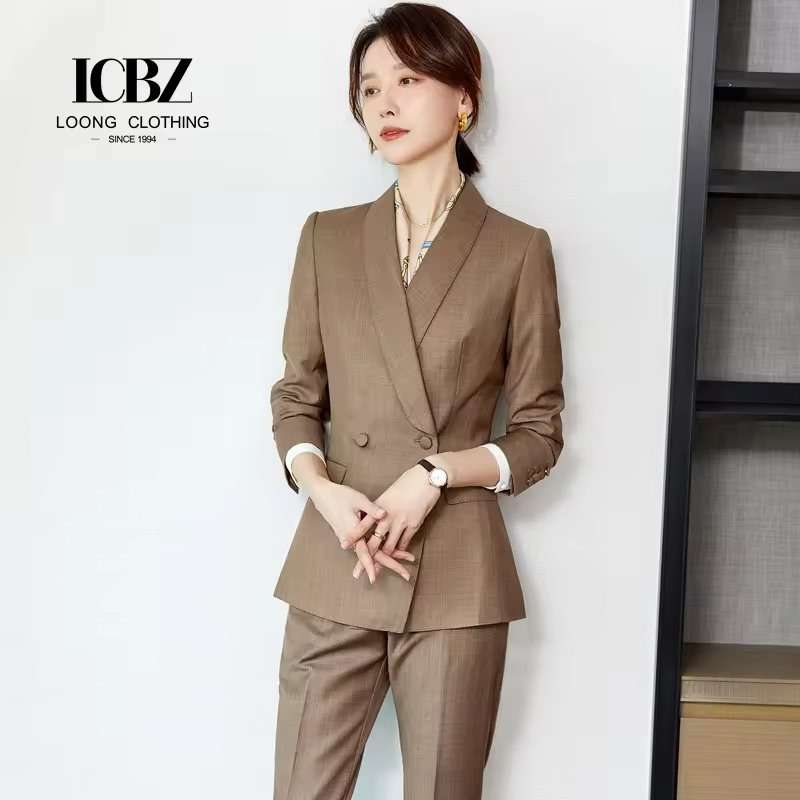
Mr. Wang, who handles wholesale sales, adds a practical note about fit consistency. “A women’s suit sells in two pieces, the jacket and the trouser or skirt, and they must be ordered together as a system. We check the jacket length against the trouser rise on real fit models, because a customer who loves the jacket will return the whole set if the trouser sits wrong.” For buyers, the lesson is to request fit samples on live models in at least two sizes, because flat measurements on a table cannot show how a jacket moves when a woman walks or reaches. wholesale ladies Workwear suits
When the conversation turns to stocking advice, Mr. Wang becomes very specific. “Wholesale buyers always underestimate how much of their demand sits in the middle sizes,” he says. “For a typical European market, the bulk of sales concentrates in a narrow band of sizes, and the extreme ends move slowly. We advise our clients to build their initial buy around that band, then add the extremes only after the first sell-through data arrives.” He also recommends reserving some budget for a second quick order, because a reorder within the same season is cheaper and safer than a deep first order that might not move.
Stocking Advice from the Production Floor
The advice does not stop at sizes. Mr. Wang points out that the same production capacity that cuts women’s business suits also runs formalwear programs, including lines for rental companies and event suppliers, which lets a buyer consolidate categories with one partner. “If your customers buy suits for work and tuxedos for events, you can place both orders on the same calendar and share the logistics,” he explains. “One quality standard, one shipping schedule, and one point of contact for two product lines is a real saving.” wholesale tuxedo
On the subject of lead times, Ms. Li is candid about what is realistic. A first order needs time for pattern confirmation and fit sampling, typically two to three weeks before production can start, while a reorder of an approved style can move much faster because the blocks, trims, and measurements are already locked. “Plan your first order early, and your reorders will be easy,” she says. “The buyers who struggle are the ones who treat every order like a first order.” tuxedo manufacturer
What Buyers Ask Most
Before we left the floor, we asked what separates the wholesale programs that succeed from those that stall. The answer was consistent: communication about fit. Buyers who share their customers’ feedback, size run data, and return reasons give the factory the information it needs to adjust the block, and the block is the heart of the whole program. “The suit is a system of measurements,” Ms. Li says, “and the buyers who understand that are the ones whose customers keep coming back for the next season.” It is a fitting summary from the people who make the suits, and the buyers who listen to it tend to order again.