
Sustainability claims in manufacturing are under more scrutiny than they used to be, from investors, from customers, and increasingly from regulators. That scrutiny is a good thing for coolant recycling specifically, because unlike a lot of sustainability initiatives, its environmental benefit comes with numbers that are easy to measure and hard to inflate.
Why Coolant Recycling Is an Unusually Clean Sustainability Story
A lot of sustainability initiatives require some interpretive leap to connect the activity to an environmental outcome. Coolant recycling doesn't. Every gallon of fluid recovered and reused is a gallon that wasn't manufactured, transported, and eventually disposed of as waste. Every reduction in disposal volume is a directly measurable reduction in a facility's waste stream. There's no need to model an indirect benefit or make an assumption about downstream impact, the metrics are the environmental case.
That directness matters more than it used to. Sustainability reporting increasingly requires documented, auditable figures rather than general statements of intent, and coolant recycling produces exactly that kind of data as a natural byproduct of normal operation.
What to Actually Track
For manufacturers building out a fluid management sustainability case, four metrics do most of the work: fluid recovery rate, the percentage of spent coolant returned to usable condition rather than disposed of; reduction in new coolant purchases, since every unit not purchased is a unit not manufactured and transported; reduction in disposal volume, tracked in gallons or hauling frequency; and water usage, since coolant recycling programs often reduce fresh water intake alongside chemical concentrate.
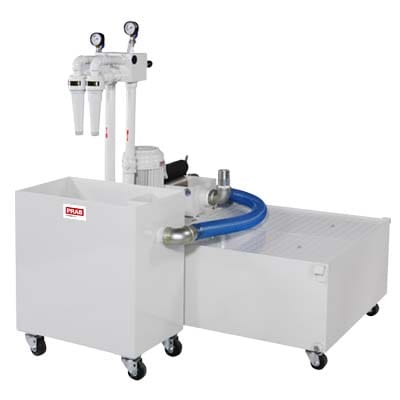
PRAB's fluid recovery systems are documented to recover up to 98% of spent coolant in well-configured installations, which gives facilities a specific, defensible number to report rather than a vague claim of "reducing waste." That kind of documented, verifiable figure holds up better under investor or customer scrutiny than a general sustainability statement ever could.
Where This Fits Into a Broader Closed-Loop Strategy
Coolant recycling rarely stands alone in a well-run sustainability program. It typically connects to metal chip processing, which recovers additional fluid from wet scrap before it ever reaches a sump, and to fluid filtration systems more broadly, which extend the useful life of fluid across the whole facility rather than treating recovery as a single point in the process. Facilities that integrate chip processing with centralized coolant recovery have documented fluid recovery rates as high as 98%, a figure that's difficult to reach through recycling alone.
Reporting It the Right Way
The instinct in sustainability communications is often to lead with the broadest possible claim. For coolant recycling, the more credible approach is the opposite: lead with the specific, documented figure, gallons recovered, percentage reduction in disposal, dollars saved in coolant purchases, and let that number carry the weight. Auditors, customers, and investors evaluating sustainability claims increasingly discount vague language and reward specificity, which happens to be exactly what coolant recycling naturally produces.
The Takeaway
Coolant recycling is one of the few manufacturing sustainability initiatives where the environmental case and the financial case are the same case, told with the same numbers. For manufacturers looking to build a sustainability narrative that will hold up under real scrutiny rather than skepticism, that alignment is worth leading with.